
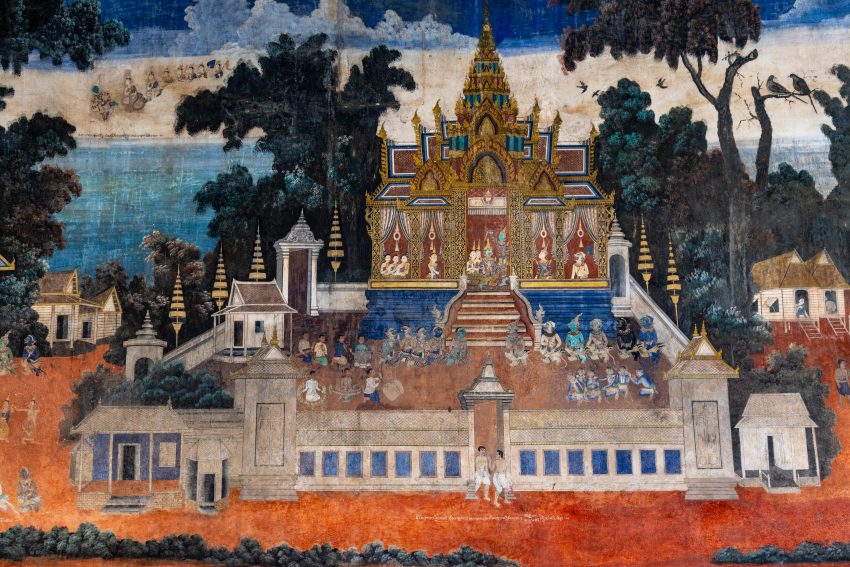
We were last in Cambodia back in 2017, when a flight cancellation reduced our time in Siem Reap to a single night. We both have very fond memories, and decide to return for a few days, before heading to Phnom Penh, which we didn’t get to last time. So, after a couple of nights in Bangkok to break up the journey from Myanmar, we’re off!
Siem Reap has over 50 temples, and getting round them all can be exhausting in the heat. So we decide to visit some of the more obscure sites that we didn’t get to last time.
Notwithstanding the foregoing, you can’t really come to Siem Reap and not see Angkor Wat. With a one day temple pass you automatically get entry to Angkor Watt at sunset the day before your tickets kick in.
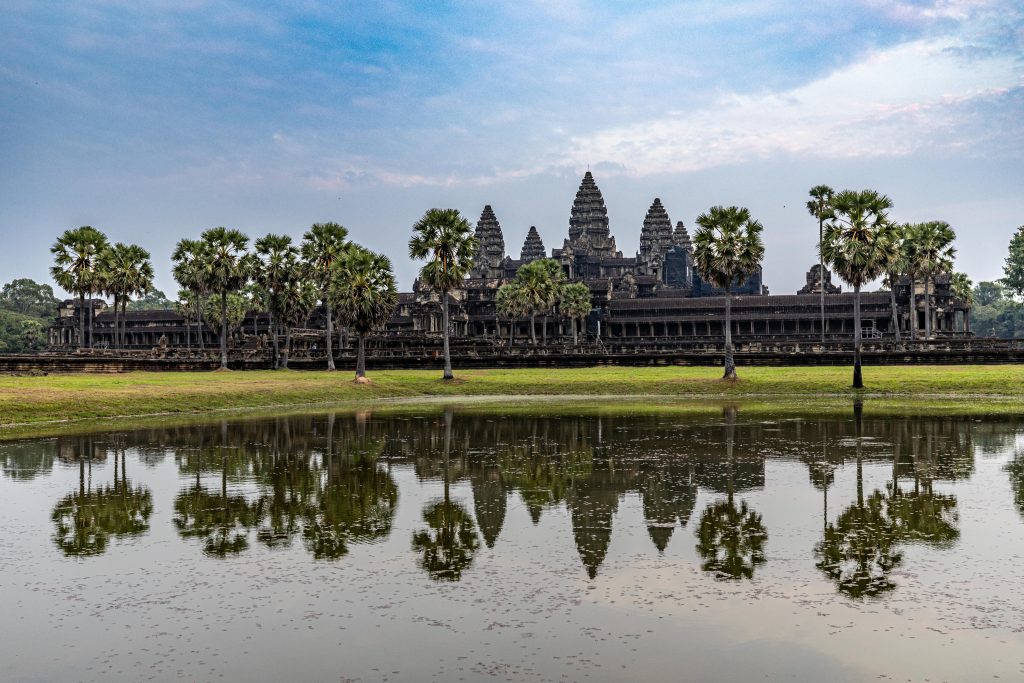
A short tuk-tuk ride sees finds us standing in the grounds of this fabulous temple once again. A fusion of Hindu and Buddhist ideologies, the site is huge, covering over 402 acres. It feels decidedly busier than last time we were here, but we still manage to get the reflecting pool to ourselves. It’s impossible not to feel a sense of awe when visiting this site, considered by Guinness World Records, to be the largest religious structure in the world, and dating back to the 12th century.


In addition to the temples we also have fond memories of the night market in Siem Reap. As we stroll down Pub Street, it feels every bit as lively as it did 7 years ago. 75 cents buys you a half-decent Cambodian lager, and the vendors still sell a variety of massively unappetising insects, arachnids, lizards, and bugs.
I cant help but give money to a young street hawker. I’m a sucker for sad, puppy dog eyes. Quickly realise my mistake, as a plethora of her friends suddenly appear from all directions. Develop repetitive strain injury dishing out dollar notes, whilst Jenn looks on with her best ‘I told you so’ look!


Next day we start our tour by driving through the impressive Victory Gate en route to Bantaey Kdei.


Banteay Kdei is quiet, with very few tourists, and turns out to be one of our favourite complexes in the area. Two corridors lead to the centre of the temple, where a kindly police officer takes our photo, artfully positioning us so that it looks as though we are holding a flame. He goes on to tell us a little about the temple, including the fact that the holes in the walls were once filled with precious stones. Must have been incredible.


I’ve never known security to be so helpful and pleasant. Who’d have thought that a police officer would have the time to help tourists. He even offers to show us around the temple. Incredible, almost too good to be true… what a nice guy!
Then comes the inevitable… “Just $10…”
So, turns out that wearing a polo shirt with “police” written across it, doesn’t make one a police officer in Cambodia! 😉 Still, he seems like a nice guy and so we take him up on his offer. He may be a fraudulent cop, but he’s a great guide and shows us parts of the temple that we would otherwise have missed.


Vowing not to be hoodwinked by security in the future, we head over to Neak Pean. Within minutes I get sucker punched again when we stop for a toilet break. Lovely local lady selling 100% silk scarfs, hand embroidered with little elephants. Amazingly, she’s prepared to offer a discount to us as her first customer of the day. Who’d have thought it?! Her persistence is impressive. When Jenn goes to the bathroom, she realises that she is left with the limping gazelle… what could I do? I hand over $5 for this undoubted bargain. Once again, I get a look of scorn from Jenn when she returns who seems less than delighted with her gift!
The lake is more impressive than the temple. Jenn’s new scarf looks awesome in the sunlight, I feel fully vindicated in my purchase… that said, it’s hot, and the 100% silk scarf starts to slowly roast Jenn alive. We begin to suspect that the label might be a slight fabrication (pun intended)…


Next stop is Pre Rup temple. It’s a decent climb to the top and must have been utterly incredible in its prime. It’s hard to appreciate the scale unless you visit in person, utterly amazing!


Although we’ve visited before. You can’t come to Siem Reap and not visit Ta Prohm. This is the temple of Tomb Raider fame. Huge trees have entwined themselves in the temples walls, and of all the temples here, it is this one that makes you feel as though you are Indiana Jones. It’s crazy busy, but worth the visit regardless.


The following day sees us drive over 5 hours to Phnom Penh. This is new to us, having not got this far on our last trip. It’s a place that we’ve both wanted to visit. We have learned during our time here about the tragic modern history of this beautiful country. Our tour guide on our last visit, recanted some of his personal experience of growing up in the shadow of Pol Pot and the Khmer Rouge, and I’ve always felt that we had unfinished business here.
NB: This not the most light-hearted post I’ll ever write – so you may wish to skip.
From our elevated hotel room you can witness a city in transition. Sky scrapers are are beginning to dominate the skyline, although much of the city remains undeveloped. A walk through the streets makes the contrast even more stark. It’s chaos – dodging motor-cycles, and street hawkers makes even a short walk challenging. Feels pretty safe for the large part, but it’s a not a place to let ones guard down.


We visit Tuoi Sleng Genocide Museum. $10 gains entrance and an audio guide, along with a map. The map warns that locations marked red may make for difficult listening and viewing, with user caution advised. This site was one of the multitudinous interrogation centres operated by the Khmer Rouge.
The abridged version of this dark part of history is as follows. Pol Pot was a revolutionary dictator, who ruled Cambodia as Prime Minister between 1976 and 1979 as General Secretary of the Communist Part of Kampuchea. The ideology involved resetting history to year 0, the start of a glorious future based on agricultural collectivism. City inhabitants were evacuated to the countryside, possessions and religion banned, and the entire population put to work in the fields for the greater good of the collective. Rice yield targets were tripled – an impossible task, particularly in light of the fact that the vast majority of displaced workers had no agricultural background.
Between the years of 1975 and 1979, the Khmer Rouge implemented an agrarian regime. So-called new people i.e. academics, people with soft hands, professionals, and religious leaders were interrogated, tortured, and executed. Over a 4 year period some three million people, 25% of the population were executed in the killing fields.
Tuoi Sleng, was one of the most notorious centres.
Upon entering, 14 marble graves mark the bodies of the prisoners that were found where they were murdered when staff fled the scene. Each of the 14 cells contain a metal bed, a munition box that served as a vestibule for human waste, and shackles. In each room, a black and white photo with the face obscured, shows the bodies as they were found. The site, holds no punches. This is humanity at its most base, and genocide laid bare.


Over the course of the tour, one learns about how uneducated Cambodians were enlisted as interrogators under the leadership of Kang Kek Lew. One of the hardest things to bear witness to, is the fact that normal people perpetrated this evil against each other. A stark choice. Either they tortured, mutilated, and betrayed each other – or that treatment was dealt upon them.
Forced confessions extending over thousands of words were extracted over weeks and months. Systematic beatings, water torture, hanging, and countless other forms of abuse were used to break down individuals and extract names of friends, colleagues, and family members.
We are particularly struck by the account of one New Zealander, Kerry Hamill. He was sailing around the world and happened to find himself in the wrong place at the wrong time. Isolated from international help, he fell victim to the regime. However, even under torture, he maintained an ironic humour, citing the fact that he worked for Colonel Sanders of Kentucky in his written confession. Neither his passport, nor his sense of humour was sufficient to save him from execution.


It’s the most uncomfortable tour I can remember. Hard to imagine how something like this could have happened during my lifetime. Reminded of Hobbes. In the state of nature, the life of man is ‘solitary, poor, nasty, brutish and short.’
In the afternoon we visit the Royal Palace Gardens. The beauty of the grounds serves as an extreme contrast with our morning tour.


Next morning we take a tuk-tuk to Choeung Ek Genocidal Center, commonly known as the killing fields. The 45-minute journey is interesting and serves to reinforce the fact that this is a city of juxtapositions. Leaving the modern financial district, with its international hotels, one quickly finds oneself driving past local markets. The smell as we pass the meat stalls is pretty powerful. Uncovered, raw meat hangs from hooks in the 30 degree plus heat, with one vendor boasting the full carcass of a cow. Its stomach-churning stuff.


Feels like a suitable precursor to what follows. Choeung Ek was the site of one of the myriad of killing fields that were uncovered after the fall of the regime in 1979. Hidden from the outside world, as many as 10,000 victims were executed at this one location.
Again, an audio tour brings the atrocities to light in an unflinching manner. The centre of the site is marked by a commemorative stupa. Even from afar, the open doors reveal, case after case of human skulls. It is intended to shock and awe.


There is little left of the original infrastructure. Undulating ground marks mass graves. Fragments of bone surface daily and are collected once every few weeks. As one walks around, fragments of human remains and clothes are clearly visible. At one stop, an assortment of bones have been collected in a glass box. Casually sat on top is a cup containing hundreds of teeth. It’s deliberately hard viewing and hard listening. The audio includes testimony from guards, executioners, and those who lost everything in the genocide.
Prisoners were dispatched in a myriad of gruesome ways. Perhaps the most poignant, being a tree used to dash children’s heads before they were unceremoniously chucked in a neighbouring pit. The tree which was found covered in unimaginable remains, is now marked with ribbons as a symbol of hope.


This site is just one of many across Cambodia. Many have yet to be discovered.
I’m struck by several things. One, this happened within living memory. After the party was overthrown with the help of the Vietnamese, interrogators and executioners returned home, living amongst the people whose lives they destroyed. Two, this happened under the watch of modern Western governments. Three, many people believe this could easily happen again.
When you bear witness to this type of crime, the past is difficult to imagine and even harder to believe. There are still many who live in denial. Some Cambodians claim that this entire episode is a fiction, a lie told by the perpetrators from Vietnam. The hard hitting nature of the genocide museum and the killing fields, is an attempt to overcome this resistance and help people understand what happened, to accept it, and to try and ensure it never happens again.
Cambodia is a beautiful country, with the most incredible ancient history. It is also a country with a dark past. I hadn’t intended this post to be quite so sombre, but, equally I don’t believe these things should be sugar-coated. If the government here have the bravery to invite witnesses to acknowledge the atrocities of the recent past, then the least I can do is to share that message.
We leave for Hong Kong a little wiser than when we arrived.
Visiting anywhere that is a witness to genocide is hard to witness but I agree it should never be swept under the carpet or it certainly will happen again . That said I am very jealous atrip to Cambodia is on my bucket list .
Terrible, sad stories from the recent past.
Did you try any of the lizards, insects spiders at all? I just couldn’t . lol
Pleased to say that we are feeling a lot better after a long time of Covid like symptoms.
Thank you for youe message on e mail.
Glad to hear that you are recovered Peter!
No spiders or lizards. I think they are a bit of a gimmick. By all accounts spiders can be quite tasty – but only if cooked well. Think I will pass however!