
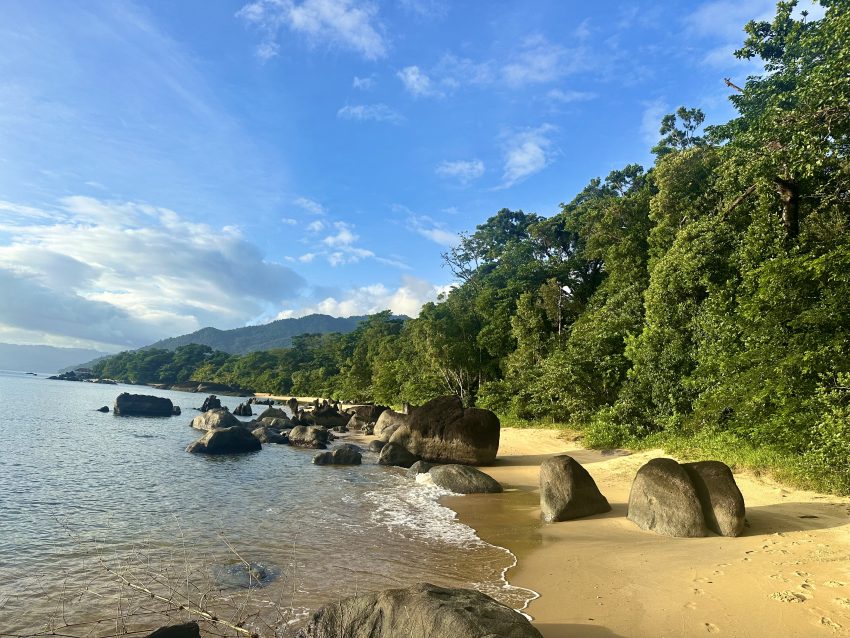
Our flight for Madagascar leaves South Africa early afternoon, which offers a small amount of time in the morning to amuse ourselves.
I’ve been looking for shark’s teeth for as long as I can remember. Every beach I walk on, anywhere in the world, I’m heads down looking through the wash. Never found one. They sell sharks teeth everywhere in Cape Town, but there’s not much by way of guidance on the internet about where to find them. I find one blog post recommending two particular beaches, about 30 minutes from Cape Town. I also watch a video from an American palaeontologist explaining how to maximise one chances of success. Equipped with this knowledge we head out. We have an hour, I’m researched, surely success is guaranteed…
First beach we visit yields no results. Quel surprise. Second looks to be going the same way, and I am about to resign myself to leaving this childhood ambition unfulfilled, when I see a triangular shape in the sand. Low and behold, it’s a fossilised shark tooth, and a pretty perfect one at that! So chuffed, I do an embarrassing victory jig on the beach!


The tooth is either from an extinct form of white shark, or an extinct species of mako. To turn as black as my sample, takes a minimum of 10,000 years, and is in all likelihood much, much older than that. It’s an incredibly tactile item, and you can feel the history in it. I love it! Feel very chuffed.
Feeling victorious, after a two-hour flight, we have a night in Johannesburg before our flight to Tana in Madagascar next day. Enough time to repack our stuff into soft cases – a prerequisite.
Madagascar is a pretty interesting place. It is roughly two and a half times the size of the UK, and much like Australia and New Zealand, home to a myriad of endemic species. Approximately 75% of the country is below the poverty line, and whilst it has circa 107 species of lemur, with current rates of deforestation it is predicted that lemurs will be extinct by 2070.
We spend a night in capital city of Tana, ahead of driving to Andasibe. It’s a long drive of nearly 5 hours, but a good opportunity to get a feel for the country. As one would expect everything is very green, with constant reminders of the poverty statistics. Feel more than a little guilty as a number of people bang on the car windows asking for money and food. A little intense, but it ceases as we reach the countryside.
We make a stop at a small private park. Within minutes our guide has found us two rather lovely coquerel’s sifaka lemurs. The lemurs are wild, but very used to humans, and grateful for the bananas that are proffered. Lemurs are primates, but evolved independently from monkeys and apes. They grab our hands in an almost childlike way to take the fruit offered. They are super cute. If truth be told, I’d never been particularly excited about the prospect of seeing lemurs, but quickly change my mind when confronted with them.


We are then shown a dizzying number of chameleons, snakes, giant moths, and frogs. Whilst closer to a zoo than a park experience, it is great to see these weird and wonderful creatures up close. Whilst you might hope to see them in the wild, they are so well camouflaged, that even with a trained eye, they must be almost impossible to spot. After 90 minutes, we feel as though we have been thoroughly spoiled.


Once at our lodge we arrange a night walk to look for the elusive mouse lemur. Eventually find one on our way home. It makes us work for a good view, and we have to traipse through sodden forest, to reach a vantage point. Easy to see how it earned its name – teeny tiny.


Next day we head into Analamazaotra national park with our guide. Secondary forest, but home to a number of lemur species. Start the morning with a nice spotting of brown and eastern bamboo lemurs. Highlight without doubt though was watching a troop (collective noun) of diademed sifaka, as they climb down to eat soil. We get to within a few feet and it was amazing to watch them go about their business without the least concern.


Last sighting of the day was the Indri, largest species of lemur, and strangely tailless. The noise they make when calling to each other can exceed 85 decibels and can carry for three kilometres.


We feel like we’ve been very lucky, a fact confirmed by our guide. Apparently, you can hike through the jungle for days without seeing more than a few glimpses of the lemurs. They can certainly put on a burst of speed when they choose to.
There’s plenty to explore back at the lodge and I even manage to find a praying mantis.


Following day we head into Mantadia. This is primary forest and at 16,000 hectares, it is a huge space. We are looking for white ruffed lemurs. Lemurs are not only endemic to Madagascar, but they are also endemic to certain regions.
We are really made to work for our sighting, wading through thick jungle, to reach our prize. Worth the effort though, very nice looking lemurs, with their huge tails making them look larger than they actually are. Tired and happy, it’s an hour and a half return trip over bone shaking roads back to the lodge. Our guide spots a giraffe weevil on the underside of a leaf as we are driving. How he saw it, I will never know.


Next morning it’s back to Tana. Six-hour drive, owing to the number of slow moving lorries that we have to navigate.
The following day is an early start, 4.45am finds us in a cab to the airport. We have a two-and-a-half-hour charter flight to reach Masoala. Interesting journey. Contrast between the logged agricultural land, and the prime forests near our destination is very marked.


Once we’ve landed it’s a 40-minute drive and then a one hour boat trip to reach our lodge. This is not an easy place to get to! At the airport we briefly meet two Americans who have just spent three days at the lodge. They seemingly had a great time and had two pieces of advice for us, ‘get used to being wet,’ and ‘don’t bother trying to look cute.’ Noted on both fronts.
The sea is rough, the rain sets in, and one is very definitely reminded of the reason that this is known as a humid rainforest. The lodge is designed to reflect an African safari, with raised tents and outdoor bathrooms. As with other humid forests we’ve visited, everything is damp. Given that the forecast is rain, that it has been raining for two weeks, and that there is a brief lull in proceedings, I decide to go snorkelling. See an adult lion fish, which is a pretty impressive size.


That evening we go for a night walk. See woolly lemurs, northern bamboo lemurs, and giant leaf geckos. The latter are apparently very rare. Come across two of these, purportedly rare, reptiles fighting. Strange contest. Dominance is demonstrated, by one male capturing the other’s head in its mouth! Subsequently see a sleeping madagascan malachite kingfisher sleeping, and an unidentified snake when filling my water bottle later that evening. Although there is a book of reptiles at the lodge, there are so many snakes here, that many only have Latin names. Very clear that there is an absolute tonne of life in and around this forest.


Jenn is up early the next day for yoga. I decide to go for a stroll. See a beautiful malachite kingfisher, and the strangest little hedgehog-like creature. The photos don’t do it justice. Imagine an easter chick with a long nose, that’s basically what it looks like. It is in fact a lowland streaked tenrec. Quite possibly one of the cutest things I’ve seen in 11 months. The locals however, are fond of eating them!


We journey later in the morning into the primary rainforest of Masoala national park. To cut a long story short, it is wet and hard work. After a very damp boat trip, we traipse through streams, and into dense patches of undergrowth. Our quarry today is the red ruffed lemur, which can only be found in this park. Despite our guide’s best efforts, our reward for three and a half hours? Drenched clothing and one solitary bird, that I didn’t even get a full shot of!


The night walk is far more rewarding, get good shots of the sportive lemur.

We try again in the primary forest next day. It’s slightly less wet as we make our way by boat to the entrance.


After about an hour, our guide tells us to wait, while he searches a particular area. 5 minutes later he’s back with a smile on his face. He took yesterday’s epic failure very personally! 😉 After a bit of elbowing through the forest we are rewarded with a red ruffed lemur. After a while it decides to move, comes onto a branch, and looks straight at us. This is the money shot. Clear line of sight and nice lighting! I raise my camera ready to take an award winning photo. Look through the eyepiece expectantly…
Nothing but fog.
Take a piece of tissue and try to wipe the lens. Still fog.
After 11 months, over 30 countries and an average of 8 hours use a day, my camera has let me down. The weatherproof lens was clearly not tested in the rainforest. The humidity has somehow got into the lens itself. I can’t believe it.
The lemur happily watches as Jenn and I bicker with each other. Jenn is of the opinion that the lens has broken because I exposed it to too much rain yesterday. She is full of useful retrospective advice about how I could have avoided said incident. There is much shaking of heads. I point out that her assessment is somewhat unfair. Our guide, whose English isn’t great, helpfully tuts and says ‘camera broken’ on repeat. I feel like climbing up the tree and sitting with the lemur!
Couldn’t have come at a worse time. Botswana is our next, and last stop!
We leave the scene and make our way back towards the waiting boat – still bickering obviously. On the way we meet a guide and some German travellers who have been looking for the red ruff for four days without success. We point them in the right direction and head on our way. After twenty minutes or so, I resignedly point my camera at a nearby tree. Miraculously it has cleared. The respite in the rain has clearly allowed it to dry!
We make a u-turn and head back to the lemur. Our new German friends are at the site. The lemurs aren’t as obliging as they had been earlier, but I get some decent enough shots.


On Friday nights the staff join guests for a traditional dinner. The table cloth and spoons are made from local leaves – and in place of plates we eat directly off the leaves. We’d been shown how to make said spoons by our guide that afternoon. Makes cleaning up easy, once we’re done, everything is rolled up and thrown away. 100% recyclable.
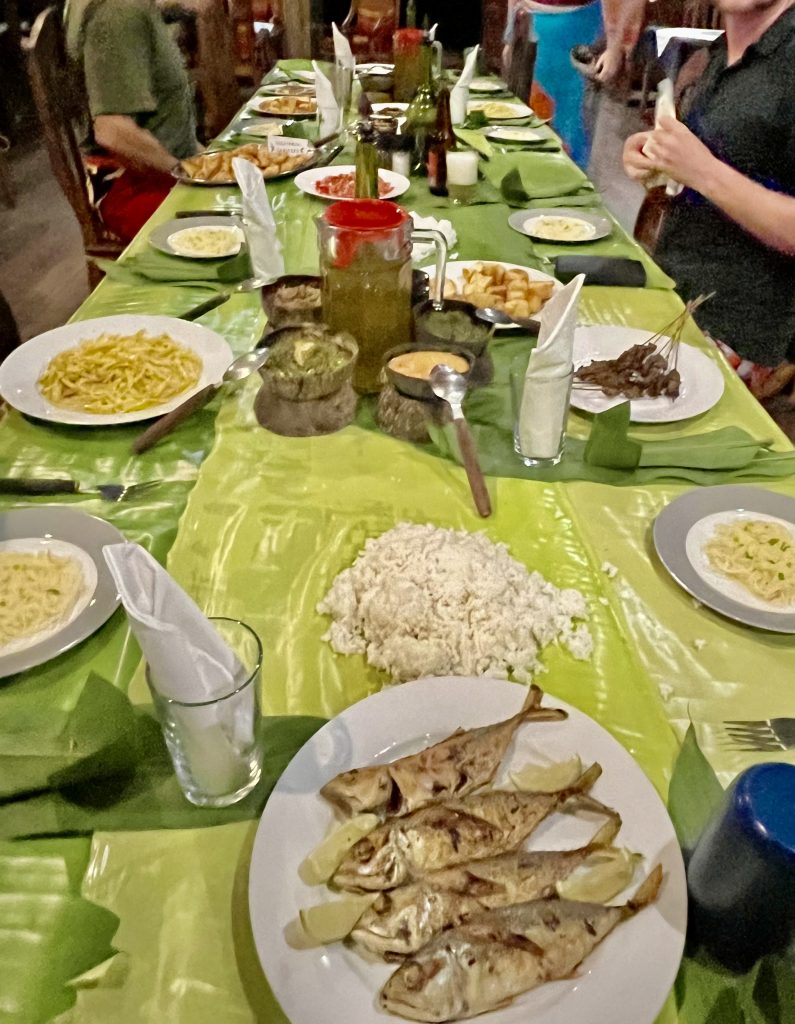
The owner also joins us. Interesting to hear about the trials and tribulations of owning a lodge in such a remote and unforgiving part of the world. Enjoy his descriptions of the various photographers and wildlife enthusiasts that have journeyed here over the years – the ‘moth people’, the ‘spider people’, the ‘snake people,’ and so on. I would imagine if you ever wanted to lend your name to a yet undiscovered form of fauna or flora, this would be a good place to start.
Lie on our slightly damp beds that evening, listening to the waves crash and the rain pour. It’s probably not for everyone, but it is truly atmospheric.
As expected, our last day in the rainforest is a complete wash out. A tropical storm north of the area has sent a bank of clouds and heavy rain. Even if we could go for walk, any creature with a shred of sense would be hiding somewhere dry. Spend the day editing photos, writing my blog, and watching those fool hardy enough (which included Jenn) try the impromptu beach sauna.


We wake next day to find that the rain is still coming down in torrents. As much as I love the wildlife here, I am not overly sad to be leaving. Haven’t been dry for four days, and everything smells of damp. One of the most amazing wildlife destinations we have ever visited, but it is hard work, at this time of year! To reinforce the point, as we drive back to the domestic airport, the water is so high in the village that it comes through the raised back door of our 4×4. Feel for the locals, the unseasonably heavy rain will have ruined crops.
Brief layover in Johannesburg, before our final stop in Botswana! The end of our trip is nigh!
Sad to hear that they expect lemurs to become extinct they are such gentle creatures