
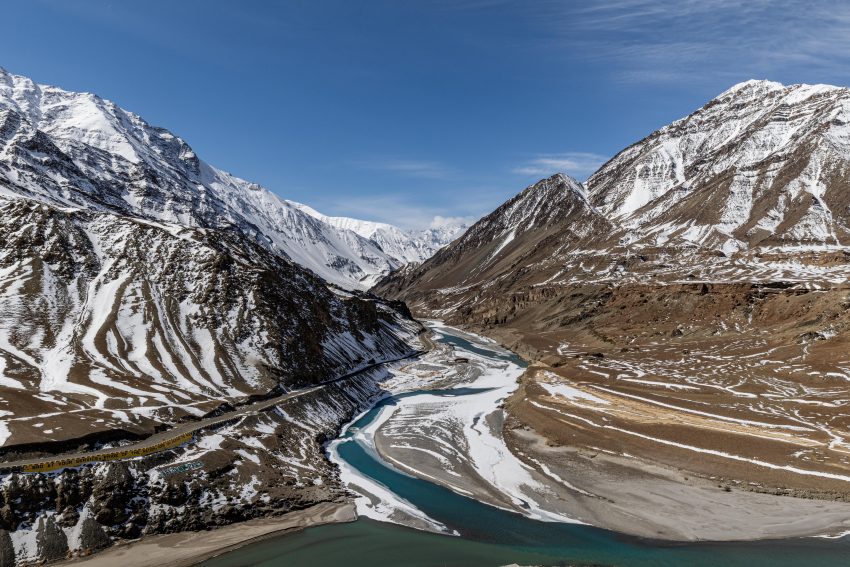
We’ve often found that some of the most interesting places are those that are hardest to reach. Ladakh, in the far north of India, was to prove no exception. After heavy snow our flight from Delhi was cancelled and a replacement offered in 3 days time. Given a mandatory two-day acclimatisation period in Leh, due to the high altitude, we would have had very limited time in leopard territory if we had taken that option. Hence a frantic rebooking saw us fly to Jammu, close to the Pakistan border, the following morning. A one-night layover, and then onward to Leh. Managed to only lose a day in transit – although it cost us a few quid.
Before you even land in Leh you know you have travelled somewhere special. Advantage of flying from Jammu is that we fly over the Himalayas, with K2 visible from the left side of the plane! The short hop from the airport offers stunning views of the snow lined peaks – it is breathtakingly beautiful.


First job in Leh is a trip to the local market. We’d bought our cold weather gear in Vietnam in preparation for the temperatures here which can fall as low as minus 10 at this time of year. To make space for our newly acquired items we’d availed ourselves of the post office in Ho Chi Minh to send some items home.
As we are repacking in Delhi before our flight north, I realise that I’ve managed to send my thick, knee-length coat home, and retained my lighter jacket! Perils of having your clothes rolled into tight rolls for packing, and having a penchant for the colour blue!
With the help of our local guide, I am soon suitably equipped with ankle boots and a down jacket. Our guide’s negotiation skills help me to get both items for the local price. The shop itself looked like a jumble sale – although I assumed there was method in the madness. I was wrong. The owner manages to locate one size 9 and one size 10. Have to give him ten minutes to find a matching pair…
The main market street in Leh lies in the foothills overlooked by looming monasteries. It is unlike anywhere else in India, and one would be forgiven for thinking they were in Tibet. The people here look and dress differently, are predominantly Buddhist, and in fact only became part of India in 1947. In the summer it is swamped with tourists – but is quiet at this time of year. With a high-speed train being built to connect the region to the rest of the country, and an international airport well underway, Leh will likely be unrecognisable in the near future. But for now, it is unspoilt and charming.


The plan for the following day is to spend the day visiting local sites to minimise any exertion and acclimatise to the 3,500 metre altitude before heading higher still. Altitude sickness is a big problem in the region and tourists find themselves in hospital with a frequency that surprises us. Taking altitude lightly can be fatal. As a precautionary measure I take medication (Jenn of course doesn’t need it). Had issues in Ecuador and Bolivia previously. Once bitten and all that…
As it pans out, we get a text that evening saying that there is a kill site in a nearby valley and they recommend we drive there. Early start and a two-hour drive through the mountains. Surprisingly there are very few 4x4s in this part of the world and so we head off in our rear wheel drive over roads that are covered in ice and snow from the unexpected weather that had resulted in our flight cancellation. At various points it looks like the car wont make it up some of the inclines, even with the hastily added snow chains.
With the skill and persistence of our driver we make it most of the way to the valley. A 30-minute walk completes our journey. Ridiculous as it may sound, a 30-minute walk at altitude is surprisingly hard work. Find that my body has to work out how to breath properly.


Upon arrival, a number of tripods can be seen holding an impressive array of cameras and scopes. At the top of the ridge we get our first sight of a snow leopard, or more specifically three snow leopards! A mother with two nearly grown cubs…

Quickly realise that snow leopards, like other cats are pretty in-active during the day. Occasionally putting their heads up, yawning, stretching a leg, but otherwise contentedly dozing in the snow. Also quickly realise that my camera, which has served me well in the rest of the world, is woefully inadequate here.
I studied a little bit of psychoanalysis at university – so well versed in Freuds reports of men’s obsession with the size of their equipment. Cannot recall anything about lens envy though, and I discover that I have a bad case of it. I look out at rows of professional tripods with an array of telephoto lenses that would shame most camera shops. Get talking to a Canadian guy, Ed, who is sat with a 600mm lens with both a 2x, and 1.4x extenders attached. Hastily hide my 500mm behind my back and shuffle back to where Jenn is standing by a scope with our guide.


The kill site is also a good distance away, but it is a hive of activity. Golden eagles, griffon and lammergeier vultures are all sat in situ chewing on the grizzly remains. They are impressive-looking birds of prey. In fact, we later learn that in certain parts of Tibet, sky burials are popular. In short, the body is chopped into pieces and left for the birds. It quite appeals.


We spend the whole day at the site, eating lunch outside overlooking the mountains. Every so often someone shouts ‘the heads up’ and people rush to their cameras and scopes, only for the deflated ‘she’s down again’ to follow rapidly on its heels. The spotters, of which there are many, have eyes like hawks and can see the slightest movement and anomaly amongst the rocks.
The day is interspersed with blue sheep, urials, and wild yaks. The latter have been the terror of tea caravans braving the journey through the mountains over the centuries. Wild yaks can be extremely aggressive, and a caravan attacked by 500 of the beasts, which can weigh over a tonne, stood little chance.


As the day draws on our leopards get a tad more active, sitting up, before eventually disappearing over the ridge for the evening, giving us a sight of their immense tails, and a nice silhouette against the skyline.
Towards the end of the day we see a fourth leopard on an opposite ridge. Day 1, four snow leopards! We had prepared ourselves not to see any. Groups, including National Geographic, can come to this part of the world for months at a time and see nothing. To have seen four in one day is incredibly lucky and we drive back to our hotel feeling tired but blessed.


Next day we make the three-hour drive to Ulley and our home for the next four nights, Snow Leopard Lodge. This is really where leopard tourism, if it can be called that, started, about 7 years ago. The journey is even more rugged than the day before with constantly shifting slopes depositing a good number of rocks on the roads, and the combination of ice, elevation, and sheer drops making it hard work for the driver. We try hard not to over think things as the car reverses at various points towards the cliff edge. This is a recurring theme over the coming days.
Just as we are nearing the lodge, a call comes in to say that there’s been a sighting in Mangue. We are offered a choice between continuing to the lodge or potential leopards… no brainer.
We pick up Norbu, en route. He is something of a local celebrity, having been involved with the lodge since inception, and widely regarded as one of the best spotters of snow leopards in the world, frequently guiding National Geographic and other research teams in the region. Documentaries have been made about him and his father. We are in very good hands.
We arrive to find two leopards on a ridge. This is a mating pair that met several days ago. In corporate terms we might describe leopards as going through a norming, storming, and performing cycle. The first encounters involve a lot of snarling and playing hard to get. Once the preliminaries are over, the pair will stay together for several days. They can mate as often as once every fifteen minutes for 5 days to maximise the odds of conception. These two are well into their courtship and look spent. Through the scope it is touching to watch them affectionately lick one another and sleep side by side. When all’s said and done they are big cats, and display many of the characteristics of our cats back home. Wish I had an empty box… I bet a pound to a penny they would make use of it! Video courtesy of Jenn…
Norbu lives up to his reputation, whilst everyone else is looking at the two leopards, he casually points out that there is a third on a different slope. This one is closer, although close is a relative term here, given that it is still 420 metres away. 7 leopards in two days…


It’s a long day and we eat lunch outside again, this time with a lovely Indian lady who is also staying at the lodge with us, Shreya. Having tried to organise a trip here with friends for three years, she eventually decided to just bite the bullet and travel on her own. Good for her! A far departure from her corporate job at a start-up in Bangalore.
Also spend a bit more time talking to Ed and his wife Lisa, who were at the site before we arrived. In this part of the world, people congregate when there’s a spotting. That said, it is so remote that there are more spotters than guests and the numbers are low. It is all very intimate, and for the large part people are very friendly, interesting, and like-minded (we won’t mention the people that arrived just before we left).
Turns out that Ed has largely abandoned his impressive camera and is relying instead on Lisa’s scope plus iphone, and P1000. The latter is a £700 piece of kit that has an impressive 24-3000mm lens. Just goes to show that its all about having the right tools for the job, not the most expensive.


Our guide, Dolkak, also gives Jenn an adapter that secures her phone to one of the scopes and means that she can get really nice photos and videos. I’m not at all jealous as I redundantly aim my own camera…
In the evening one of the leopards decides it has slept enough and goes on a bit of a stroll. Really amazing to see the animal at full stretch and walking dexterously across the snowy ridges. They really are incredible. The tail is almost as long as its body, the head looks disproportionately small, they boast 5000 hair follicles per square inch, and are more closely related to tigers than other types of leopards. Aside from mating season, they are largely solitary, patrolling territories that can exceed 25 miles.


It’s a long day and we get to the lodge in the dark. The lodge is really a glorified homestay. Very quaint and we are glad of the stove in the main room, and a cup of Khawa, a local tea said to be very good for altitude sickness. There is no running water at the lodge – although we are told its coming soon. Until then a bucket system suffices. Red bucket contains hot water for washing, blue bucket, cold water for manually flushing the toilet. It wouldn’t be for everyone, but we knew what to expect, and people do not travel here for five-star luxury. As we are told, ‘Ladakh is a place so remote that only your best friend, or worst enemy, would bother to follow.’ Food is excellent and the staff are really lovely. Go to bed, with a hot water bottle, two duvets and a wood-fired stove in the room.


We are woken at 7am with a hot cup of tea, a fresh bucket of hot water, and watch as the stove is re-lit. Spotters have been out since first light at around 6.30. Routine here is to grab a tea and head out onto either the balcony or the lower slopes with the spotters. We see ibex (including two males fighting) and golden eagles (had no idea that golden eagles can travel at speeds of 200 mph when diving), before heading back for breakfast.


At 10am every day reports come in from across the valleys and a call is made about where to head. It turns out to be a reasonably quiet day. Although we do see Himalayan wolves, which are at least as rare as snow leopards.
The fact that it’s quiet, means we get a chance to get to know Ed and Lisa a bit better. They are ridiculously well-travelled, and have been to Ladakh twice before. Their first visit was 15 years ago, when there were no roads, or mature infrastructure, and getting any type of phone signal involved climbing a peak! Spent a month hiking with Norbu, and in that entire time had three sightings. They returned again in November last year and drew a blank. Just goes to show, snow leopards are far from a given.
Ed is an artist. He and Lisa travel widely photographing animals which he then meticulously recreates in his studio. His work is stunning. I particularly like the field sketches that he draws on location. A good use of his philosophy degree – which as we all know is the only respectable subject to study at university. They also run a small travel agency, Lisa makes jewellery, they sell curios from their travels in their shop near Niagra and spend a significant portion of the year travelling – enviable lifestyle.


At the lodge that evening we meet some new guests, two ladies from the US, Janet, Dee Ann, and their local guide, Gulzar. The latter has been at the lodge since inception, and over the next few days, we find his knowledge invaluable.
Following day is another long day outside. No leopards, but good sightings of wolves, culminating in an early evening climb to a vantage point. Again, patience is key. The sun is warm in the afternoon making this an area where one can ‘get frostbite and sunstroke in the same day.’


Really enjoy the conversations with our new friends. Always a pleasure to speak to fellow travellers and wildlife enthusiasts. That said, I will very definitely be hiding my photos from Dee Ann, a professional photographer, who has taken some stunning, award-winning photographs over the course of her twenty-year plus career. Starting to realise the patience and dedication required to put oneself in the right place, with the right kit, so that when the right time comes you can take the perfect shot. That said, I tend to take pleasure in most things I see, so enjoy being in the environment and taking opportunistic photos.
For me, in this part of the world, the photos we get capture the moment, rather than being perfect examples of their type. This is of course me trying to justify the poor performance of my equipment – pun intended! 😉
We say a fond farewell to Shreya, Ed, and Lisa. No grand finale unfortunately, but I suspect both will be back again…
Next day we chase shadows, going from location to location with limited success.


That said, our last full day has a final treat in store for us. Late in the afternoon our spotters somehow pick out a leopard on a slope over 2km away. Even through a scope it is hard to spot.
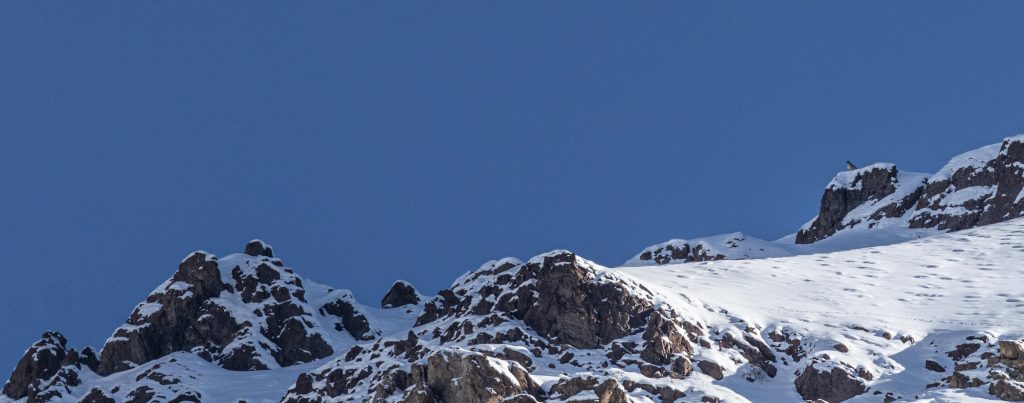
They also spot a group of four ibex nearby. Game on.
The leopard heads in the direction of the prey and disappears amongst the rocks. Our guides advise that it will attempt a kill. Get ready. As ever I’m tripod-less, so find a semi-covered piece of ground and lie down to try and stabilise the camera. Through my lens I can see the Ibex, but they are tiny in my view finder. I just have to aim in that direction, and be ready to click away at the first sign of movement. It takes a while. My hand and arm ache from holding the camera in position and the cold is biting when motionless. That said, the anticipation is electric.
All at once everything kicks-off. I see a dot emerge from the rocks, the ibex scarper, and a chase down the mountainside. It’s over in seconds. Leopards are explosive, ambush hunters, if they miss with the first attempt it is almost impossible for them to bring down a full-grown ibex. The snow is crazy deep as well, almost entirely obscuring the leopard.
Not many people get to see a snow leopard hunting, feel like we’ve joined an exclusive club.
I have no idea what I’ve captured until I start looking at the playback screen. Looks like I’ve caught the attack, it’s tiny – but it captures the attempt. Later that evening looking at the photos, zoomed-in to within an inch of their life, I can see what actually played out.
The leopard attacks from the nearby rocks, flying spreadeagled at the nearest ibex. It lands on an impressive set of horns. No chance of clinging on from there. Thrown off, the leopard is not done yet, and makes a second attempt. Second miss. The ibex is simply too strong. It all plays out in milliseconds. The other ibex have barely left the frame, in the time it has taken the leopard to make two attempts.
The chase down the mountain feels like a token gesture and the leopard is easily outpaced. Photos below sort of capture it… but certainly don’t do the experience justice. Utterly amazing!


The next day we leave Snow Leopard Lodge, but not before we head out to one final sighting. Get there a fraction too late and the leopards have disappeared amongst the rocks. The closest we are destined to get is when the local villagers bring out handmade stuffed leopards and Ibex. Would definitely have bought one, had we had any luggage space left.


At around 11am Jenn and I call it a day and head back to Leh, having said goodbye to Janet, Dee Ann and the raft of spotters and guides that have made our trip so very special. Journey back to Leh is bitter-sweet, looking forward to a hot shower, but we are already missing the remoteness of our home for the last few days.
We’ve been incredibly lucky. Not even the legendary David Attenborough has seen a snow leopard in the wild. Without doubt one of the most beautiful and remote places we have visited. I only hope that the influx of visitors in the coming years does not destroy what makes this place so special. Selfishly, I would prefer this place remained a well-kept secret.
We will be back. Have unfinished business with the Pallas’s cats…
Stunning we adopted a snow leopard last year so maybe you saw ours!!